The Big Read: Prolonged pandemic tests trust between bosses and workers - and the picture isn't pretty for some
Advertisement
Singapore
The Big Read: Prolonged pandemic tests trust between bosses and workers - and the picture isn't pretty for some
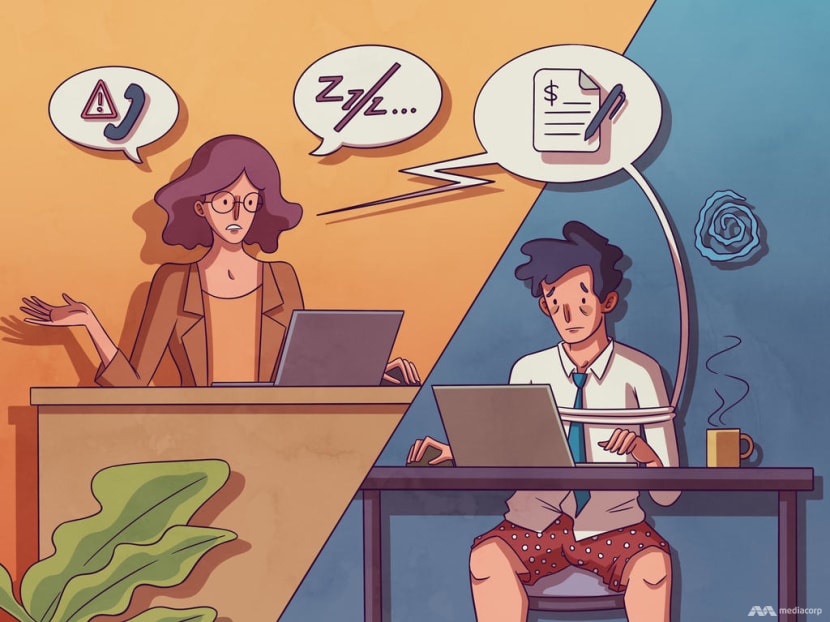
Almost two years afterward work-from-home was foisted upon many organisations, issues such as ensuring productivity and developing mutual trust go on to dog employees and employers. (Image: TODAY/Anam Musta'ein)
- Even though remote working has get a style of life for many in Singapore, employers and employees are yet trying to detect the mutually optimal arrangements
- Commonly cited issues that need to exist addressed centre around trust, productivity and mental wellness
- Human resources experts say embracing work-from-home or work-from-anywhere is the only way frontwards and companies who do non exercise then volition lose out on talent
- However, employees also have to exercise self-responsibleness over how they manage their own work
27 Sep 2022 06:09AM (Updated: 27 Sep 2022 02:16PM)
SINGAPORE: While working from home, Cheryl (non her real proper name) was non required, at to the lowest degree officially, to be at her desk all the time. Yet, she withal felt pressured to give her then employers that very impression.
To forbid her status on communication platforms such as Microsoft Teams or Skype for Concern from turning "inactive", the marketing professional would go back to her desk-bound to move her mouse every 10 minutes or so even though she had to step abroad for a while.
In gild for her managers to monitor what she was doing, she also had to make all her work calls, including to external parties, through Microsoft Teams. Such a practice, every bit well as her managers' throwaway remarks during virtual meetings, made her feel like she was being tracked.
"From the things that they said — like 'nowadays, we don't hear annihilation from this person, is she fifty-fifty working?' — information technology made me paranoid about myself, even though it was not directed to me," said Cheryl, at present 29, who left the company in Nov concluding yr after about 12 months on the chore.
So, there was Ms Wong, who had to constantly update her employer on what she was working on via a designated group chat, after she requested to piece of work from home when tighter COVID-19 restrictions were reimposed during a state of heightened alert in May.
The 31-year-old, who declined to give her full name, was part of the marketing team in a food and beverage company at the fourth dimension. She said that her so supervisors would send her messages reminding her to report to them every day since she was being paid a salary.
Such negative work-from-dwelling house experiences — arising from either the workers' own insecurity or their bosses' penchant to micromanage, or both — accept led some employees to quit their jobs despite the uncertain economic outlook.
Michelle (not her real name), a graphic and spider web designer in her 30s, changed jobs twice within the concluding 18 months equally she felt that both of her sometime employers had footling regard for staff well-beingness.
When work-from-home was first implemented at the company she worked at during the excursion breaker from April to June last year, Michelle said her supervisors would go along tabs on whether the staff were online or not through Microsoft Teams.
"They kept hyperfixating on the red dot (inactive) and greenish dot (online) ... And they would use that afterwards on during group meetings where they could verbally scold people: 'Your work is only this much considering you lot haven't been online you know,'" she said.
According to Michelle, during one virtual meeting, i senior manager said: "I know you lot all at home actually have nothing to exercise. Very free."
She resigned at the tail cease of the circuit billow — only to bring together another company that did not adhere to the Ministry building of Manpower's (MOM) informational for work-from-abode to be the default arrangement when the heightened alert was imposed.
The frustrations with the business firm's disregard for COVID-19 rules built up to a point where Michelle had a mental breakdown 1 night and started crying non-stop. She subsequently went to meet a doctor to become feet medication.
"The dr. said to me: 'Is this medication going to help solve your trouble or practice you lot demand to go to the root of the problem and think about leaving your job?' That night, I realised I couldn't proceed doing this to myself.
"Honestly, in that location I was sobbing away. The visitor didn't have a single clue and probably wouldn't intendance even if I told them," she said.
Well-nigh two years after work-from-dwelling was foisted upon many organisations amid an unprecedented coronavirus pandemic, issues such every bit ensuring productivity and developing mutual trust from a altitude continue to dog both employees and employers alike.
And it looks like something they will however be grappling with in the foreseeable future.

From Monday (Sep 27), work-from-home volition once more be the default arrangement in Singapore until October 24, every bit the Government introduced new restrictions to halt a surge in COVID-19 infections, which have climbed to more than 1,000 cases on some days.
Human resource experts said that more than e'er, it is important for employers to focus on "trust" issues, such every bit incorporating building trust in their approach to leadership and management.
Ms Rachele Focardi, a time to come of piece of work strategist, said: "As far every bit Singapore organisations (are concerned), if the terminal 15 years have shown us annihilation, it is that they are not moving along with the times, creating the all-time possible environment for employees and adapting to the needs of the new generations is not an option."
Dr Michael Heng, director of People Worldwide Consulting, said that the power difference between employers and employees tends to be greater in Asian economies than in Europe or the The states.
"We are non very warm people. Bosses don't walk up to your desk and ask 'how are you lot doing?' ... You may say it's due to reserved Asian culture," he added.
FIRMS' INITIAL CHALLENGES
While remote work has proved to exist a boon for many — such as savings in commuting time for employees and office infinite rental for employers — some companies shared they were initially concerned most how such a work arrangement would affect organisational results and productivity.
Mr Lim Hong Zhuang, chief executive officer of blockchain start-up ShuttleOne, said one major concern he had was keeping his employees engaged and ensuring they collaborated with one another while working from home.
"Also, how practice we go the attending of our employees with then many things that may distract them, like having WhatsApp open on the browser, during calls et cetera," he said.
Mr Leong Chee Tung, principal executive officer of homo resources beginning-upwards EngageRocket, said he had been worried about integrating new hires, ensuring there was clarity and immediacy in communication, too every bit getting staff to stay creative.
Mr Dutch Ng, chief executive officer of technological security business firm I-Sprint, had to deal with teething bug such every bit providing remote access to staff, communicating with backend staff and sharing information.
While Mr Douglas Abrams, the chief executive officer of venture capital house Expara, had initially resisted the idea of working from home, he now sees it equally a future trend.
"When this situation was forced with COVID-19, having experienced it myself and seeing the benefits, it's correct. Definitely the way to go," he said.
This embrace of work-from-home did non happen overnight, as companies shared how it was a process of trial-and-fault every bit they searched for the optimal arrangement.
Even now as the dust settles, some employers said they were still tweaking their workflow by remote processes.
Mr Leong, for example, has adult people management processes suitable for his company past taking a leafage out of other tech companies' books.
Something as simple as using emojis more than often is one communication technique he had picked up along the way.
"When you don't have non-verbal feedback, when the dominate asks a question, information technology could be an innocent question, merely they may wait at it and think, 'Are they questioning me? Is it a threat?'... Emojis are in that location to assistance to convey more than simply text."
His visitor had initially held video meetings quite regularly, thinking that such sessions were important to prevent its employees from losing affect with each other and "switching off".
However, over the months, Mr Leong realised that his employees found it draining and detrimental to their mental health. As such, the management has decided that attendance at most video meetings is no longer mandatory.
For Mr Lim, his company took near one twelvemonth to settle on what would piece of work for them.
"We were evaluating all the tools available and being nimble in changing. We changed email dashboards, many tools," he said.
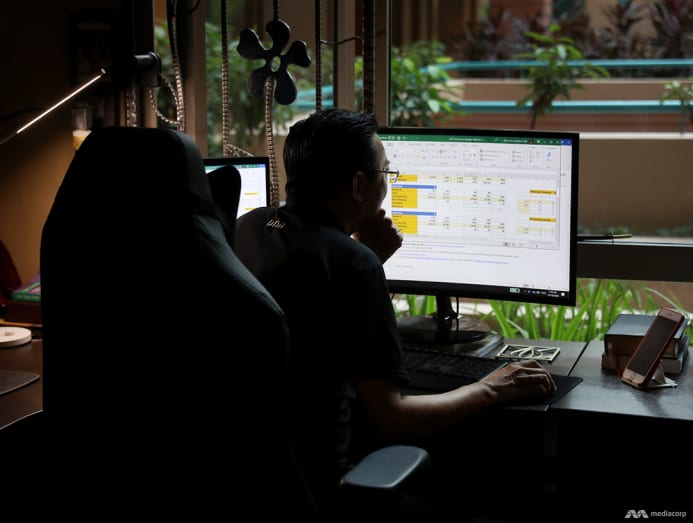
At home appliance visitor Electrolux, daily or weekly huddles with team leaders were used every bit a grade of feedback channel for the management on how staff felt about work-from-habitation arrangements, said Ms Joanna Bilewicz-Porzycka. She is the vice-president of human resources and communications at Electrolux's Asia-Pacific, Middle Eastward and Africa division.
The management realised that their staff needed to accept more space to recharge, so they revisited their workloads and meeting schedules in the concluding 2 months. They also tried to ensure that limited calls took place in the evenings with other employees based outside of Singapore, and that it only required relevant staff to be in omnipresence.
"It's really these small things that make a difference and requite room for our employees to make up one's mind for themselves — when to step in to join a meeting and when to focus on other things of their pick," Ms Bilewicz-Porzycka said.
Some other companies, especially non-tech ones, establish the transition to work-from-domicile to be harder, however.
A staff member from the human resource department of an compages firm, who did non want to be named as he had not been authorised to speak to the media, said that the nature of architectural work is all-time washed face-to-face given that it is highly collaborative and discussions often involve looking over drawings or material samples.
"I'yard non saying it can't be done. Just there are a lot of hurdles," he said.
Subsequently 18 months of working from home, Ms Koh Qin Wen, a full general director at an education company, said she still wonders whether more could be washed to increase the productivity of her staff.
While Ms Koh said she does not micro-manage, and volition have it when her staff tells her that they don't have the fourth dimension or resources to accept on additional projects, there is a part of her that still questions such responses at times.
"There is always the idea of 'could they practise more, could they do better?' At the stop of the day, if the results show, then information technology is fine. Merely I always wonder whether they are actually working the full 40 hours per week or not," she said.
Listen to EngageRocket CEO Leong Chee Tung and HR strategist Adrian Tan fence the merits of returning to the office once rules lift on CNA'due south Heart of the Matter podcast:
POLICIES AND PRACTICES IN PLACE
To compensate for the lack of human interaction, some companies take implemented various measures, such as weekly or daily virtual meetings for staff, to provide work updates.
Team-bonding events are held well-nigh, such every bit group exercises or discussions on mental health, or virtual coffee breaks.
Several firms have too incorporated several software tools they had not used pre-pandemic into their workflow processes.
Mr Lim's blockchain firm uses a tool where each employee's task is listed on a virtual board that can be seen past everyone, and staff can bank check off each task when they are done, after which a report would be sent to him for review.
Work calls and tasks are too organised into strict 90-minute sessions as that is the maximum duration people can stay focused, said Mr Lim.
Mr Vincent Wong, director of research and avant-garde engineering at the Singapore segmentation of automotive firm Continental, said that his company employs visualisation and analytical tools that bring transparency to project functioning.
Some companies too prepare their own unique requirements for work-from-abode staff.
For Mr Leong's company, there is an agreement that staff should ideally reply to letters within 10 minutes, though information technology is not mandatory.
At Multiverse, another blockchain commencement-upwardly, there is an unspoken rule that everyone needs to turn on their cameras during virtual meetings, said its co-founder Cliff Szu.
While Mr Chionh Chye Kit, chief executive officer of regulatory tech house Cynopsis, does not place restrictions on where his staff could do their work, they are discouraged from heading to food and potable outlets.
"I would rather my people not work in the cafe because they are exposed to a mask-off surroundings for an extended menstruation of time," he said.
Even as they tweak further their internal processes, some companies said they will continue with their current hybrid model of work — where staff tin can cull to work from anywhere outside the office, or get back to the role when needed or when they experience like information technology, subject field to the government'due south prevailing rules.
Every bit for Ms Koh, she has started a airplane pilot trial of getting her team dorsum into the office three days a week, and this system is likely to continue if rules permit.
Mr Oo Gin Lee, the managing manager of public relations firm Gloo, said that he is exploring options with a co-working space operator, where his staff will be able to work at co-working spaces most their homes just by booking a hotdesk or a meeting room via a mobile application chosen Switch.
"Nosotros have (an office in) central location, but people who live in Tampines, Jurong cannot go back to work, so they can use Switch to go to a nearby hot desk," he said, adding that such an organization volition besides benefit staff who can't work from home for various reasons.
Ms Focardi called such a work system every bit "hub and spoke", where companies provide employees with the power to piece of work from anywhere, including outside the home.
She said companies are increasingly looking at the option of having membership with a number of co-working spaces throughout the city, where employees can choose one that is the closest to their home.
This could besides help improve employees' mental wellness, since the lack of separation between work and home has been 1 of the major complaints about working from home.
Ms Focardi also said that at that place may be more cafes pivoting to some sort of membership-based co-working space to cater to this demand.
Mr Michael Sim, the head of co-working operator JustCo, said that information technology has seen an increase in demand for flexible workspaces from many new clients.
"These big corporates are pivoting towards hybrid piece of work arrangements and are embracing flexible workspaces where they get a highly customisable mix of office solutions for different purposes, such as temporary headcount (and) workforce decentralisation," he said.
The occupancy rates of JustCo'due south workspaces currently ranges between 80 per cent and 85 per cent, which is similar to levels before COVID-xix, said Mr Sim.
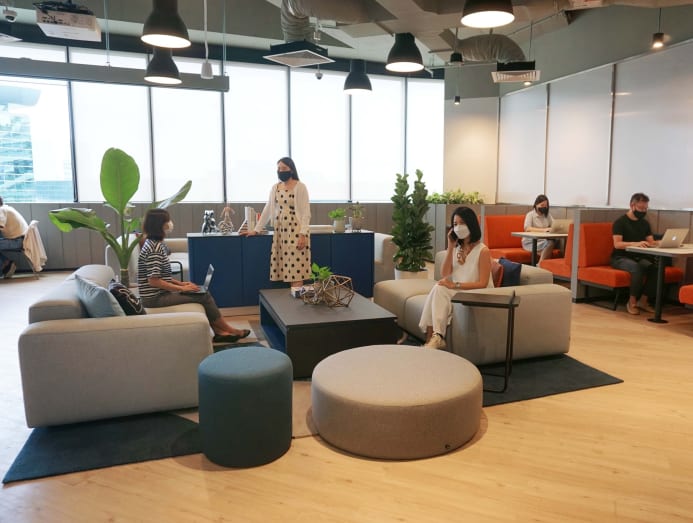
As for WeWork, its general manager for Southeast Asia, Mr Balder Tol, said that it has expanded its infinite in response to the increasing demand for flexible and hybrid work arrangements.
Information technology likewise launched a monthly membership for companies to bask access to workspace and meeting rooms in WeWork buildings, as well as i for individuals where they can pay for each use.
On Friday, the Tripartite Brotherhood for Off-white & Progressive Employment Practices released a series of guides, which incorporate best practices that companies tin implement to foster better work-life balance, even equally these two spheres accept been increasingly blurred with work-from-home becoming dominant.
Mr Victor Mills, chief executive of Singapore International Chamber of Commerce, said that the guide on work-life practices which his squad adult lays out how the management should set the broader strategy of what values the company stands for, how middle-level managers should implement it and how employees should practice self-responsibility and brand an attempt to expect later on themselves.
Amidst the serial of guides is likewise one on how companies can limit after-hours communication. 1 example is to implement a rostering arrangement for staff in roles where they have to exist contactable all the time, said Mr Daniel Chia, caput of homo resource at Samsung Electronics, who was also involved in cartoon up the guides.
Both Mr Mills and Mr Chia are members of the Alliance of Action on work-life harmony.
While the best practices are not mandatory, Mr Chia said they will encourage businesses to prefer them for commercial success.
However, Mr Mills recognised that a mindset change is the hardest to bring virtually. What they tin practice, along with the unions, employers and Government, is to provide the resources, he said.
Building a workplace culture where employees feel appreciated and respected would be cardinal in developing a set of best practices for one'southward visitor, said Dr Heng, from People Worldwide Consulting.
And these can be pocket-sized actions, such every bit praising employees when they perform well, or passing on the contact of a bodyguard if any staff is facing problems with childcare.
Dr Heng said that other work-from-abode best practices include providing laptops for staff, redefining methods to measure out job performance, giving feedback and discussing ideas more regularly and being transparent with how the visitor is doing.
EMPLOYEES' EXPERIENCES
While some employees take to bargain with micromanaging bosses attributable to a lack of trust, in that location are others with more positive experiences.
Mr Elston Aw, 31, who works remotely in Singapore for a start-up based in New York, said that his managers practise not track how long he works as long equally he makes himself bachelor for meetings late at dark here due to time zone differences, and completes his task.
The software engineer said that the flexibility afforded past his company is one reason he decided to have on this role full-time after interning and office-timing for them while he was an undergraduate.
"I want to work feeling like I am a artistic, rather than beingness monitored and existence a cog in the machine," he said.
Another remote employee, Mr Hamren Misai, who works in the maritime industry, said he just has to make sure he is responsive to emails.
"They (bosses) keep tabs on us, no doubt about information technology. Only equally long as I respond to emails, they have nothing to say," said the 34-year-one-time.
Rachel (not her real name), a 32-year-old working in the finance manufacture, said that the trust her bosses accept for her has been built over the pandemic.
When work-from-home just started, she received a morning greeting just one minute after her official start time, which she felt was a way for her bosses to check whether she was online.
Just this stopped over fourth dimension and she is beholden of her managers who don't crave face-time.
"I feel COVID-xix helped with that because employers were forced to, so no choice. Information technology took some time," she added.
Apart from trust, one other effect that has cropped up when work-from-home started was concerns over employee productivity.
Mr Ong Bo Xian, 31, said subconsciously, he has this feeling that whatsoever time of the twenty-four hour period can be used for work due to the lack of separation between home and the office.
"There is this psychological lure, a seduction into beingness more relaxed and not so hard on yourself during the work day because you know you can catch upward after," said Mr Ong, who works as a legal counsel.
While he is taking a longer time to complete his work, he said his output has not been affected, as it is commencement past the fact that he saves time on commuting.
For others like Ms Ashley Chen, 31, having blurred boundaries has, in fact, turned out to exist more than productive for her.
Ms Chen, who does marketing for a travel agency, said that the flexibility of work-from-anywhere ways that she has been able to work without being role of a routinised environment. This has helped her consummate the travel guidebook her company is working on as she can piece of work on it over the weekends and at nighttime.
She works mostly at a cafe in Chinatown, which is run by her employer, just she has the flexibility to be constantly on the motility.
"It really depends on my mood … Most of the fourth dimension, it's just finding places that allow me to stay longer every bit at that place are a lot of dining-in restrictions .. It'due south e'er nice to have a change of environment," she added.
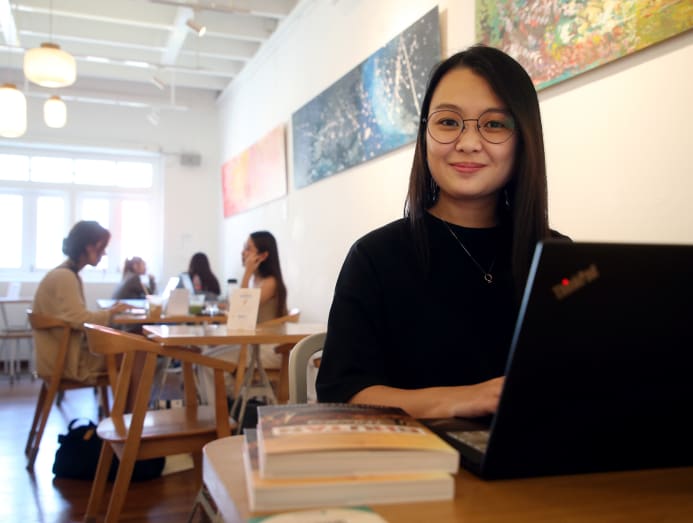
Isolation, withal, is 1 common downside cited past employees interviewed.
Rachel said it can experience lonely without colleagues effectually and the small size of her house has too fabricated her feel very claustrophobic.
Mr Aw, on the other paw, misses the presence of a mentor whom he, equally a fresh undergraduate, can constantly turn to for guidance.
When he gets stuck at piece of work, he often has to wait until the end of the working twenty-four hours to contact his manager who is in New York.
Like IT OR NOT, THE FUTURE IS Hither
Whether they like information technology or not, companies take no pick but to embrace work-from-anywhere arrangements. In that location is no fashion they tin return to the traditional work arrangement even after COVID-nineteen is fully brought under control, man resource experts said.
Hence, allowing staff some degree of remote or flexible work is the but way forrad, they noted.
Ms Focardi said younger cohorts who bring together the workforce desire to feel trusted and empowered, and they will non want to work for organisations that seek to monitor them.
"(Companies) take had enough time to realise by now, that if you don't move with the times, you can't be successful. You're just gonna trail behind," she said.

Nevertheless, unfortunately, many companies still seem to recollect that things are going to return to pre-pandemic days, said Mr Mayank Parekh, master executive officeholder of Establish for Man Resource Professionals.
"What will happen is that if yous want to have good talent, if you desire to position your company well in item for the younger workforce, then I recollect you demand to take this as a given," he added.
Yet, it takes two easily to clap. Employees too demand to exercise self-responsibility.
"So I think there is a limit to what the company tin do. Opportunities are there, but individuals also have to step upward," said Mr Mayank.
"If, for instance, you lot are someone that wants to exist around people only you can't become to the office, perchance you can work in Starbucks or a workspace somewhere where yous tin can exist around people," he said.
Dr Heng said employees need to be trained to take control over their own operation management and also speak up to inform their managers about any difficulties which they are facing.
Ultimately, experts said that both companies and employees need to discover ways to suit to the new reality, and information technology is normal for both parties to take the fourth dimension to find the sugariness spot that works for them.
Every bit Ms Koh pointed out, it is about finding the remainder betwixt what the staff want and what is best for the company.
For more news like this, visit todayonline.com.

Recent Searches
Trending Topics
Source: https://cnalifestyle.channelnewsasia.com/singapore/work-home-trust-issues-bosses-staff-covid-19-pandemic-295391
0 Response to "The Big Read: Prolonged pandemic tests trust between bosses and workers - and the picture isn't pretty for some"
Postar um comentário