Creative Edge Sacramentos Arts Culture and Creative Economy Plan
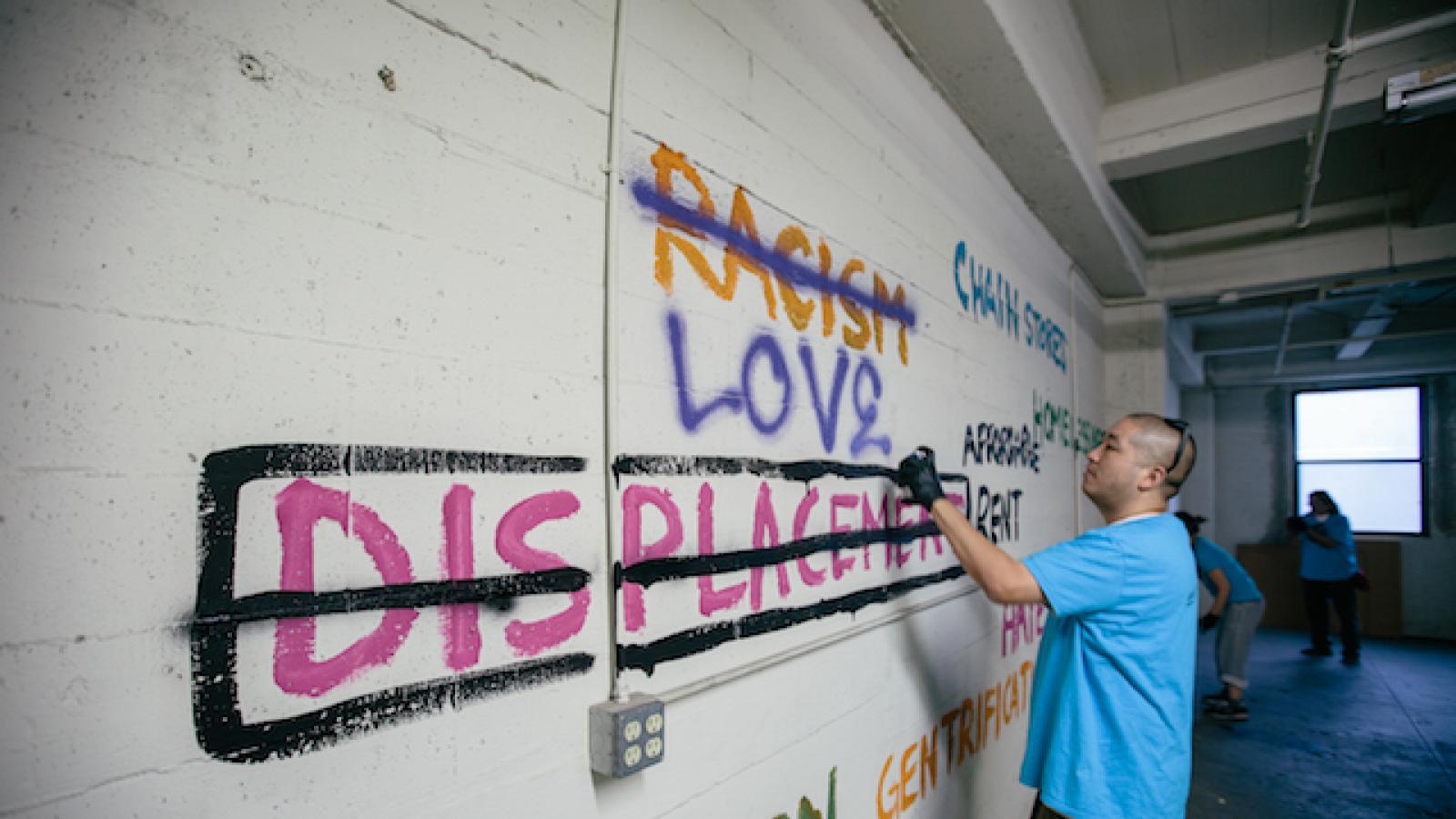
Piddling Tokyo Service Center staff apply colorfully painted text to activate the vacant VIDA building to prepare the community for changes in Los Angeles, California. Photo courtesy of Petty Tokyo Service Eye, by Rudy Espinoza
The first of a new year is always a time to reverberate on growth and evolution, every bit well equally a time to set intentions for how to motion forward. If at that place's one thing we collectively tend to feel during this process, information technology's that change is hard.
This is simply as true professionally as it is personally, and certainly even more truthful when we recall about our organizations and systems. And yet, as agents of change, we can't but imagine the world as we want it to be and expect to magically get at that place; we have to—in large and small means—learn new practices, shift our mindsets, and adjust our systems and protocols to enact this vision.
The growth of creative placemaking as a serious do is not just near how many artistic placemaking projects happen in the world—it is as well about how we shift the relationships betwixt and operating systems of artists, arts organizations, and the field of community development.
In November 2019, the Federal Reserve Bank of San Francisco published a second, seminal periodical event of their Community Evolution Innovation Review entirely defended to the question of what changes when we invite arts and cultural strategies into the practice of community development (the first, "Artistic Placemaking," was released five years prior in 2014). Titled "Transforming Customs Evolution through Arts and Culture," this result of the journal collects a series of essays and reflections that together seek to showcase why and how primal community development leaders, organizations, intermediaries, and funders are learning to partner with artists, incorporate cultural lenses into their thinking, and address some of the nearly challenging issues in communities with newfound inventiveness. The periodical issue was co-edited by the San Francisco Federal Reserve, ArtPlace America, and PolicyLink, a national inquiry and action institute dedicated to advancing economic and social disinterestedness.
Chairman Mary Anne Carter delivered remarks at the journal's kick-off result at the Yerba Buena Arts Center in San Francisco to reinforce her essay in the periodical—and celebrate the success of the National Endowment for the Arts Our Town grant plan. Since 2010, Our Town, the signature artistic placemaking programme of the Arts Endowment, has helped diverse community leaders and organizations build partnerships to help transform communities into lively, beautiful, and resilient places with the arts at their core, and, in the spirit of the journal, have also helped community development institutions to practise the systems change work of being able to regularly and sustainably partner with the arts and culture sector long-term.
You lot can read information technology all here—only what's in it?
Clocking in at 202 pages, reading the journal comprehend to cover may seem like an aggressive undertaking, but the journal has something for everyone—starting time-person accounts from customs development organizations, essays by artists, commentary by researchers and leaders around the field, and analyses of policy and funding. Collectively, these articles show us that when artists are invited to assist co-design processes in community development, the results are extraordinary.
The first and largest section is focused on the ArtPlace Community Development Investments programme, which has invested deeply in half-dozen community development organizations, from the Cook Inlet Housing Potency in Anchorage, Alaska, to the Jackson Medical Mall Foundation in Jackson, Mississippi, to the Fairmount Park Salvation in Philadelphia, Pennsylvania. Through three-yr investments, ArtPlace challenged each of these organizations to work in a new way—and discover how arts and cultural strategies can help support and expand their missions and relate to the communities they serve in deeper and more than inclusive ways. For instance, in Zuni, New United mexican states, local artists helped the Zuni Youth Enrichment Project pattern a new park to promote cultural resilience; in Southwest Minnesota, artists are helping the Southwest Minnesota Housing Partnership to further incorporate new voices into community planning and pattern processes; and in Little Tokyo in Los Angeles, California, artists are helping the organization to blueprint new anti-displacement strategies in a climate of rapid development. Equally the voices from these organizations and communities show, arts and cultural strategies have the potential to deepen community date and organizing practices; strengthen the social fabric of communities; and attain key housing, health, and neighborhood goals.
We know this kind of work isn't merely a passing tendency, and it isn't only happening in the arts sector. Information technology is taking hold both in community development organizations and in the systems that serve them. Major national community evolution agencies that drive conversations about national best practices are making deep investments to ensure that arts and civilization become a role of community development long into the future. For instance, recognizing the value of arts and culture to the customs evolution field, the Local Initiatives Support Corporation (LISC) has incorporated creative placemaking as a key pillar of its Catalyzing Opportunity arroyo to economic evolution every bit a way of elevating community identity and power.
Now imagine the possibilities in a earth where all customs development begins with the visions and values of artists, civilization-bearers, and our commonage inventiveness rather than having to figure out how to include them downward the line. In the final section of the periodical, Rip Rapson of the Kresge Foundation and Michael McAfee of PolicyLink help u.s.a. to understand that civilization is a lens that helps the states understand and procedure the earth through our humanity, and that artists are an essential ingredient to accept at the table in building equitable futures.
The key lesson throughout all of these pieces is that every bit a growing field, we need to keep to find ways to provide the infinite and resources not just for collaboration on individual projects, merely for deep learning processes that brings new ways of working and knowing into all of the systems that are imagining and enacting new futures for communities. As that happens, the question no longer becomes, "Are the arts valuable investments in communities?" only rather, "How could we ever imagine doing community development without these lenses and practices informing every step of the mode?"
In their article on Creating Process for Modify, the Center for Performance and Civic Practices provides this logic for doing and then—and inspiration that tin take all of us into the new twelvemonth!
If place is geography bound past shared meanings,
if identify plus time equals alter,
what does change do to meaning?
How is meaning shaped? Past whom? For whom?
Artists go along, make, and transform pregnant. It is what they do. Their relationship to place, in addition to inhabiting it, is to see it and mind to it. Whether intentionally or not, every creative human action, every moment of imagination and expression in a identify, contributes to that place's shape.
Source: https://www.arts.gov/stories/blog/2020/transforming-community-development-through-arts-and-culture
0 Response to "Creative Edge Sacramentos Arts Culture and Creative Economy Plan"
Postar um comentário